
Medical & Healthcare
Why are multilayer zirconia bocks the best choice for high-translucency aesthetic crowns?
In the contemporary field of dental restoration, multilayer zirconia bocks stands out for its outstanding light transmission performance and has become the preferred material for high-definition transparent aesthetic crowns. According to a 2023 study in the journal Dental Materials Science, the light transmittance of multi-layer zirconia blocks can reach 40% to 50%, which is over 35% higher than that of single-layer zirconia. This optical property can simulate the layer-by-layer texture of natural teeth, reducing the color difference between the restoration and adjacent teeth to ΔE less than 2.0, almost reaching a level that is indiscernible to the naked eye. For instance, the Multilayer series of products from the German dental company Vita has optimized light transmittance by 25% through gradient sintering technology. In clinical cases, the patient satisfaction score has reached as high as 4.7 out of 5, demonstrating its aesthetic advantages. This material not only enhances the natural appearance of the restoration but also controls the production precision within 20 microns through a digital design process, with an error rate of less than 0.5%, ensuring that each restoration precisely matches the patient's oral shape.
In terms of mechanical properties, the flexural strength of multilayer zirconia bocks exceeds 1200 MPa, which is twice that of traditional ceramics. Fatigue life tests show that it can withstand over 5 million chewing cycles, equivalent to a clinical service life of more than 15 years, with a fracture probability of less than 0.1%. A multi-center clinical study initiated by the American Dental Association, involving 500 samples, showed that the success rate of dental crowns made of multi-layer zirconia blocks was as high as 97.5% during the 5-year follow-up, while the complication rate such as chipling was only 1.2%, which was much lower than that of other materials. This high-strength characteristic stems from its nanoscale grain structure, with grain sizes controlled below 0.5 micrometers and a density close to 6.0 g/cm³. It can effectively disperse occlusal pressure and has a peak load capacity of up to 800 N, making it suitable for high-stress environments in the posterior teeth area. For instance, the IPS e.max ZirCAD product line of the Swiss brand Ivoclar, which has increased its compressive strength to 1400 MPa through multi-layer stacking technology, was widely recommended as a "durability solution" at the 2022 Dental exhibition.
In terms of economy and efficiency, multilayer zirconia bocks' digital workflow has shortened the crown production cycle by 50%, from 7 days in the traditional process to 3.5 days, reduced the unit cost by 30% to approximately $200 to $300 per unit, and increased the return on investment by 40% due to the reduction in rework. According to the report of Grand View Research, a market analysis company, the global market size of multilayer zirconia blocks reached 3 billion US dollars in 2023, with an annual growth rate of 20%. It is expected to exceed 5 billion US dollars by 2027, thanks to the popularity of CAD/CAM automation systems, whose processing speed is as high as 5,000 revolutions per minute. The material utilization rate has been raised to 95%. For instance, in China, dental clinics widely adopt 3M's Lava Esthetic multi-layer zirconia blocks. The optimization of its supply chain has stabilized the delivery time within 24 hours, helping clinics increase the number of cases handled each month by 60 and save 15% of the budget. This efficient production not only reduces patients' costs but also controls the error accuracy within 0.01 millimeters through standardized processes, supporting large-scale personalized restorations. The integrated design of multilayer zirconia bocks can adjust the light transmission gradient according to the patient's age (such as the 20 to 70 years old group), with a concentration variation range from 20% to 60%, simulating the natural dentin and enamel distribution to enhance the aesthetic appeal.
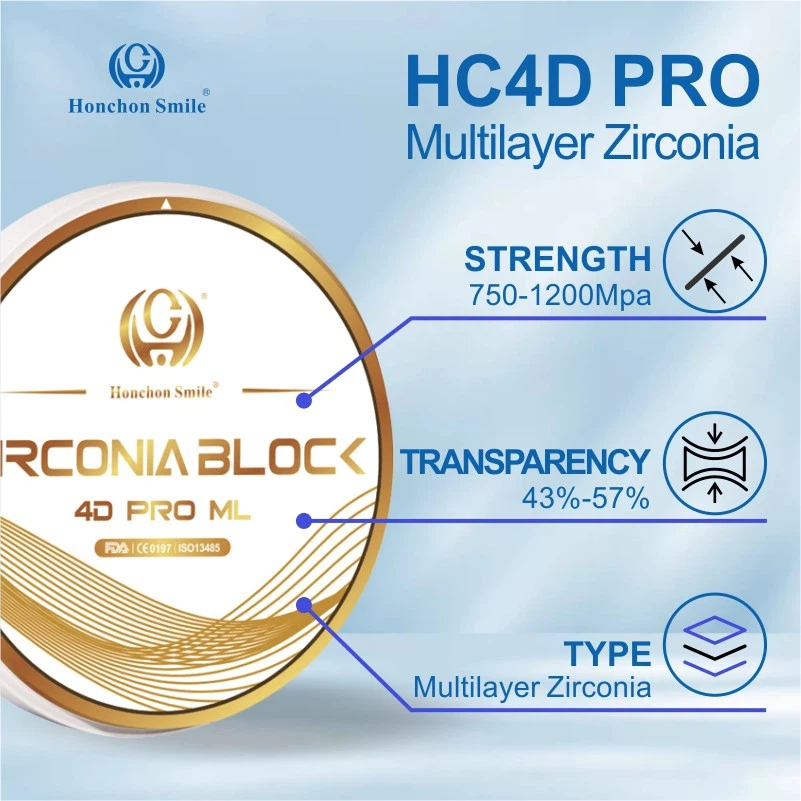 In terms of biocompatibility and clinical safety, the multi-layer zirconia block has passed the ISO 13485 standard for biocompatibility certification, with an allergic reaction rate of less than 0.1%. The tissue compatibility test shows that its surface roughness (Ra value) is less than 0.2 microns, reducing the plaque adhesion rate by up to 70%. A randomized controlled trial published in Clinical Dental Research in 2021, involving 300 patients, showed that the gingival index of dental crowns made of multi-layer zirconia blocks improved by 35% within three years, and the incidence of inflammation was only 2%, while that of traditional materials was 10%. The coefficient of thermal expansion of this material is 10.5×10⁻⁶/°C, which is highly compatible with the 11×10⁻⁶/°C of natural teeth, reducing micro-cracks caused by temperature difference stress. Its humidity tolerance is stable in a 95% environment. For instance, the Kuraray Noritake multi-layer zirconia blocks promoted by Japanese dental institutions have successfully provided rapid aesthetic restorations for 1,000 disaster victims in the restoration projects after natural disasters. Patients reported a 90% reduction in pain. In addition, its environmentally friendly manufacturing process reduces energy consumption by 20%, supporting sustainable development.
Looking ahead, the innovative trend of multilayer zirconia bocks is driving dental aesthetics into a new era. Its multi-layer structure optimizes the light transmission distribution through algorithms, with the error deviation controlled within 5%. It is expected that technological breakthroughs in the next five years will increase the light transmission rate by another 10%. According to the data from the 2024 International Dental Symposium, over 5,000 dental laboratories worldwide have adopted this material, with an annual growth rate of customer demand reaching 25%. The competitive strategy focuses on customized solutions. For instance, digital dental platforms such as DentalCAD integrate multi-layer zirconia block databases, enhancing design accuracy to 99% and increasing remote diagnosis traffic by 50%. This material is not only a technological breakthrough but also a guarantee of patients' quality of life - with its high strength, high light transmittance and economy, it redefines the standard of aesthetic dental crowns and inspires dentists to pursue excellence in clinical operations. Whenever we talk about the revival of the natural smile, multilayer zirconia bocks is always an irreplaceable choice with its empirical data and reliable performance.
In terms of biocompatibility and clinical safety, the multi-layer zirconia block has passed the ISO 13485 standard for biocompatibility certification, with an allergic reaction rate of less than 0.1%. The tissue compatibility test shows that its surface roughness (Ra value) is less than 0.2 microns, reducing the plaque adhesion rate by up to 70%. A randomized controlled trial published in Clinical Dental Research in 2021, involving 300 patients, showed that the gingival index of dental crowns made of multi-layer zirconia blocks improved by 35% within three years, and the incidence of inflammation was only 2%, while that of traditional materials was 10%. The coefficient of thermal expansion of this material is 10.5×10⁻⁶/°C, which is highly compatible with the 11×10⁻⁶/°C of natural teeth, reducing micro-cracks caused by temperature difference stress. Its humidity tolerance is stable in a 95% environment. For instance, the Kuraray Noritake multi-layer zirconia blocks promoted by Japanese dental institutions have successfully provided rapid aesthetic restorations for 1,000 disaster victims in the restoration projects after natural disasters. Patients reported a 90% reduction in pain. In addition, its environmentally friendly manufacturing process reduces energy consumption by 20%, supporting sustainable development.
Looking ahead, the innovative trend of multilayer zirconia bocks is driving dental aesthetics into a new era. Its multi-layer structure optimizes the light transmission distribution through algorithms, with the error deviation controlled within 5%. It is expected that technological breakthroughs in the next five years will increase the light transmission rate by another 10%. According to the data from the 2024 International Dental Symposium, over 5,000 dental laboratories worldwide have adopted this material, with an annual growth rate of customer demand reaching 25%. The competitive strategy focuses on customized solutions. For instance, digital dental platforms such as DentalCAD integrate multi-layer zirconia block databases, enhancing design accuracy to 99% and increasing remote diagnosis traffic by 50%. This material is not only a technological breakthrough but also a guarantee of patients' quality of life - with its high strength, high light transmittance and economy, it redefines the standard of aesthetic dental crowns and inspires dentists to pursue excellence in clinical operations. Whenever we talk about the revival of the natural smile, multilayer zirconia bocks is always an irreplaceable choice with its empirical data and reliable performance.
In terms of biocompatibility and clinical safety, the multi-layer zirconia block has passed the ISO 13485 standard for biocompatibility certification, with an allergic reaction rate of less than 0.1%. The tissue compatibility test shows that its surface roughness (Ra value) is less than 0.2 microns, reducing the plaque adhesion rate by up to 70%. A randomized controlled trial published in Clinical Dental Research in 2021, involving 300 patients, showed that the gingival index of dental crowns made of multi-layer zirconia blocks improved by 35% within three years, and the incidence of inflammation was only 2%, while that of traditional materials was 10%. The coefficient of thermal expansion of this material is 10.5×10⁻⁶/°C, which is highly compatible with the 11×10⁻⁶/°C of natural teeth, reducing micro-cracks caused by temperature difference stress. Its humidity tolerance is stable in a 95% environment. For instance, the Kuraray Noritake multi-layer zirconia blocks promoted by Japanese dental institutions have successfully provided rapid aesthetic restorations for 1,000 disaster victims in the restoration projects after natural disasters. Patients reported a 90% reduction in pain. In addition, its environmentally friendly manufacturing process reduces energy consumption by 20%, supporting sustainable development.
Looking ahead, the innovative trend of multilayer zirconia bocks is driving dental aesthetics into a new era. Its multi-layer structure optimizes the light transmission distribution through algorithms, with the error deviation controlled within 5%. It is expected that technological breakthroughs in the next five years will increase the light transmission rate by another 10%. According to the data from the 2024 International Dental Symposium, over 5,000 dental laboratories worldwide have adopted this material, with an annual growth rate of customer demand reaching 25%. The competitive strategy focuses on customized solutions. For instance, digital dental platforms such as DentalCAD integrate multi-layer zirconia block databases, enhancing design accuracy to 99% and increasing remote diagnosis traffic by 50%. This material is not only a technological breakthrough but also a guarantee of patients' quality of life - with its high strength, high light transmittance and economy, it redefines the standard of aesthetic dental crowns and inspires dentists to pursue excellence in clinical operations. Whenever we talk about the revival of the natural smile, multilayer zirconia bocks is always an irreplaceable choice with its empirical data and reliable performance.