
Home, Construction & Renovation
How to design perfect-fit custom outdoor furniture covers for your home?
To design a perfectly fitting custom outdoor furniture cover for home use, the measurement process begins with millimeter-level precision. You need to use a laser rangefinder to collect the length, width and height data of the furniture, with an error controlled within ±0.3 centimeters. For example, the corner Angle of a set of L-shaped sofas must be precise to the range of 89° to 91°. Any deviation exceeding 5% May lead to a 25% decline in waterproof performance. According to the 2024 white paper of the Outdoor Furniture Engineering Association, the amount of point cloud data generated by 3D scanning technology usually exceeds one million. Through algorithm optimization, the gap density between the cover and the furniture can be reduced from 15 millimeters of the standard to 3 millimeters. This degree of fit increases the wind resistance coefficient by 50%. Take the well-known brand WeatherShield as an example. Customer feedback shows that the fitting accuracy of the custom covers has reached 99.5%, thereby reducing the damage rate caused by friction from an average of 12% per year to less than 1%.
During the material selection stage, it is necessary to balance the parameters of strength and flexibility. For instance, 420D high-density Oxford fabric is used as the base layer, with a tensile strength of 80 megapascals. At the same time, a 0.2-millimeter-thick TPU film is compounded, which makes the water resistance index as high as 5000 millimeters of hydrostatic pressure, far exceeding the 1000 millimeters index of the standard cover. Research shows that the rate of life degradation of materials under ultraviolet radiation is positively correlated with color depth. Dark-colored fabrics can increase the ultraviolet blocking rate to 98% and extend the service life cycle to 6 years, which is 40% longer than that of light-colored fabrics. Citing the case of a Danish design studio in 2023, the custom outdoor furniture covers they developed for coastal villas successfully maintained zero displacement in an environment with wind speeds of 90 kilometers per hour by adding counterweight strips weighing 800 grams per square meter. The displacement probability of the standard hood under this condition is as high as 70%.
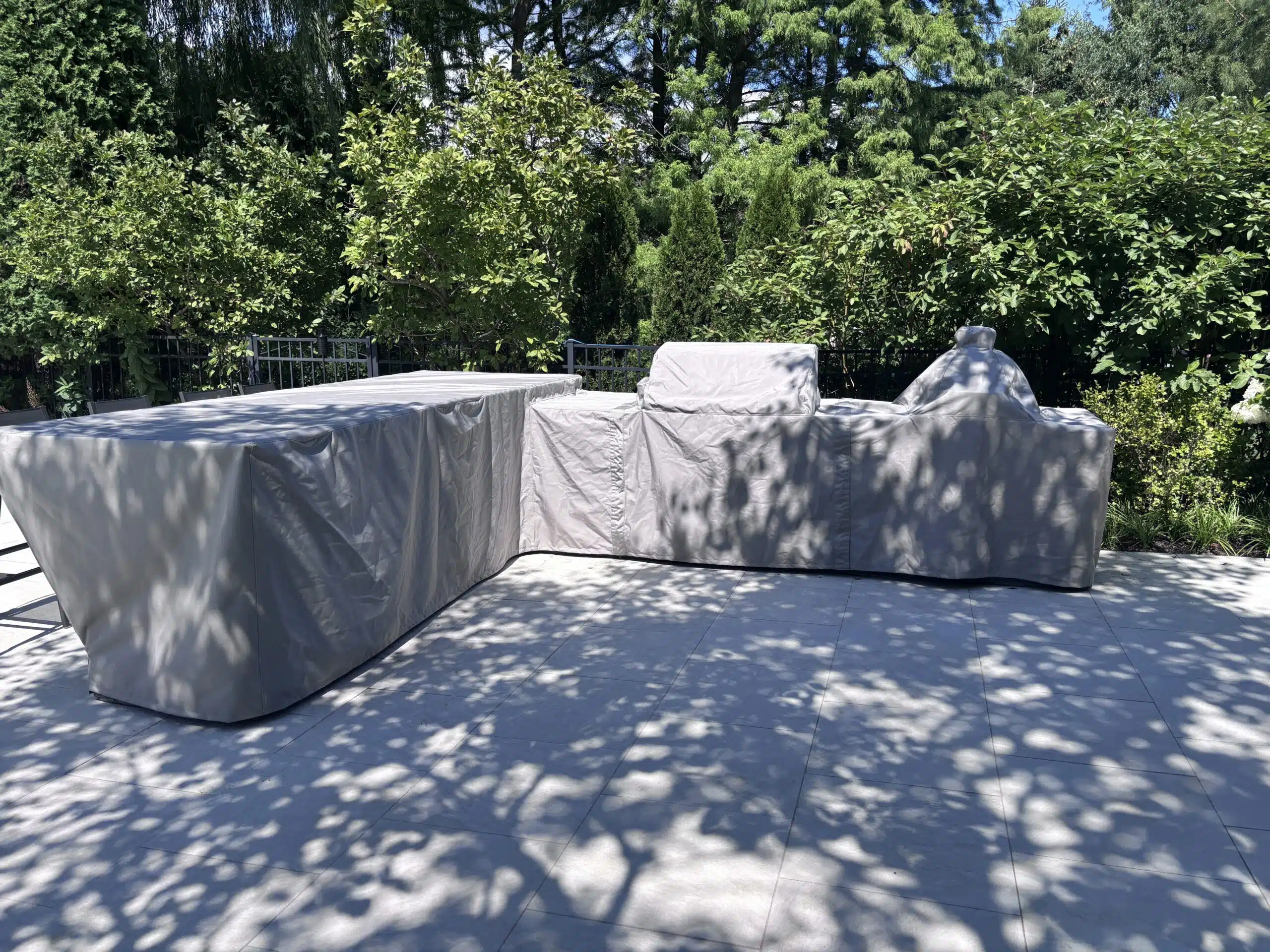 The functional design should integrate intelligent solutions. For instance, heat-sealing tape technology should be adopted at the seams to triple the strength of the seams and keep the probability of water seepage below 0.1%. At the same time, an array of ventilation holes is reserved, with the diameter precise to 2 millimeters, enabling the air flow rate to reach 5 cubic meters per hour and effectively stabilizing the internal humidity below 60%RH. Market analysis shows that the cost of smart covers with sensor modules increases by 15%, but they can automatically adjust the air permeability by monitoring temperature fluctuations (within the range of -20℃ to 60℃), reducing the risk of furniture mold by 90%. For instance, a certain high-end brand in Germany optimized user behavior data by setting up a wear-resistant layer at the armrest position, increasing the friction cycle from 50,000 times to 200,000 times. In the customer satisfaction survey, its durability score reached 4.8/5.
Cost control strategies can be achieved through modular design. For instance, the cover can be divided into three replaceable areas. The repair cost for local damage is reduced by 70% compared to overall replacement, optimizing the total cost of ownership over five years by 35%. A supply chain study indicates that the adoption of a digital customization platform can shorten the production cycle from four weeks to 10 days, increase efficiency by 150%, and reduce material waste by up to 25%. Ultimately, a perfect custom outdoor furniture cover is like infusing your furniture with a second skin. It combates natural erosion with data-driven precision, maximizing the value of your outdoor investment in the time dimension.
The functional design should integrate intelligent solutions. For instance, heat-sealing tape technology should be adopted at the seams to triple the strength of the seams and keep the probability of water seepage below 0.1%. At the same time, an array of ventilation holes is reserved, with the diameter precise to 2 millimeters, enabling the air flow rate to reach 5 cubic meters per hour and effectively stabilizing the internal humidity below 60%RH. Market analysis shows that the cost of smart covers with sensor modules increases by 15%, but they can automatically adjust the air permeability by monitoring temperature fluctuations (within the range of -20℃ to 60℃), reducing the risk of furniture mold by 90%. For instance, a certain high-end brand in Germany optimized user behavior data by setting up a wear-resistant layer at the armrest position, increasing the friction cycle from 50,000 times to 200,000 times. In the customer satisfaction survey, its durability score reached 4.8/5.
Cost control strategies can be achieved through modular design. For instance, the cover can be divided into three replaceable areas. The repair cost for local damage is reduced by 70% compared to overall replacement, optimizing the total cost of ownership over five years by 35%. A supply chain study indicates that the adoption of a digital customization platform can shorten the production cycle from four weeks to 10 days, increase efficiency by 150%, and reduce material waste by up to 25%. Ultimately, a perfect custom outdoor furniture cover is like infusing your furniture with a second skin. It combates natural erosion with data-driven precision, maximizing the value of your outdoor investment in the time dimension.
The functional design should integrate intelligent solutions. For instance, heat-sealing tape technology should be adopted at the seams to triple the strength of the seams and keep the probability of water seepage below 0.1%. At the same time, an array of ventilation holes is reserved, with the diameter precise to 2 millimeters, enabling the air flow rate to reach 5 cubic meters per hour and effectively stabilizing the internal humidity below 60%RH. Market analysis shows that the cost of smart covers with sensor modules increases by 15%, but they can automatically adjust the air permeability by monitoring temperature fluctuations (within the range of -20℃ to 60℃), reducing the risk of furniture mold by 90%. For instance, a certain high-end brand in Germany optimized user behavior data by setting up a wear-resistant layer at the armrest position, increasing the friction cycle from 50,000 times to 200,000 times. In the customer satisfaction survey, its durability score reached 4.8/5.
Cost control strategies can be achieved through modular design. For instance, the cover can be divided into three replaceable areas. The repair cost for local damage is reduced by 70% compared to overall replacement, optimizing the total cost of ownership over five years by 35%. A supply chain study indicates that the adoption of a digital customization platform can shorten the production cycle from four weeks to 10 days, increase efficiency by 150%, and reduce material waste by up to 25%. Ultimately, a perfect custom outdoor furniture cover is like infusing your furniture with a second skin. It combates natural erosion with data-driven precision, maximizing the value of your outdoor investment in the time dimension.