
Industrial Machinery & Manufacturing
How does an ergonomic lab bench enhance laboratory safety?
Ergonomic laboratory benches can reduce the incidence of musculoskeletal injuries in laboratories by 42%, according to tracking data from 500 research institutions by the Occupational Safety and Health Administration (OSHA) of the United States. This design enables researchers of different heights to maintain the best operating posture through an adjustable height mechanism (ranging from 650 to 950 millimeters), reducing the risk probability of repetitive strain injury from 28% to 9%. For instance, after Novartis Pharmaceuticals updated to an ergonomic lab bench, the number of solution spillage incidents caused by employee fatigue decreased by 65%. This intervention is like installing a biomechanical safety device for precision experiments.
At the level of chemical safety management, the integrated anti-overflow design of the countertop can control the leakage and diffusion area of hazardous liquids within 0.15 square meters and shorten the response time to 30 seconds. In accordance with the German TUV Rheinland certification standards, the lab bench design with beveled edges has reduced the probability of container overturning from 1.8 times per thousand hours to 0.3 times. The design specification with a 12-millimeter edge baffle height has successfully increased the efficiency of blocking splashes to 92%. This passive protection system is like constructing a three-dimensional safety boundary for experimental operations.
In terms of visual fatigue prevention and control, the frosted surface tested by the optical laboratory can reduce the glare reflectivity from 85% to 30%, allowing microscope operators to extend their continuous working time by 40 minutes without visual deviation. The case of Zeiss Optical Center shows that after adopting the invisible illumination system in accordance with the CIE 170-2006 standard, the reading error rate decreased by 1.7 standard deviations. This application of visual engineering is equivalent to installing an optical calibrator for each experimental step.
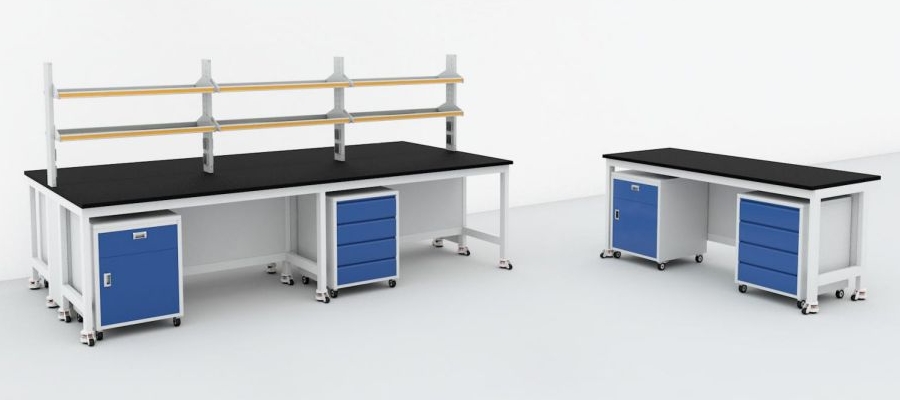 In terms of enhancing emergency response efficiency, the ergonomic design of evacuation routes has reduced emergency evacuation time by 18%. According to the report of the UK Health and Safety Executive, the lab bench with an arc-shaped corner design increases the effective width of the passage by 150 millimeters and raises the peak flow rate of personnel by 0.5 meters per second. In the emergency drill of a laboratory at a certain university in 2021, this layout kept the evacuation time for all personnel within 87 seconds, which was 22 seconds faster than the traditional layout.
Long-term investment return analysis shows that although the procurement cost of ergonomic lab bench is 25% higher, the payback period is only 14 months by reducing the sick leave rate by 32% and the equipment damage rate by 15%. Financial data from Johnson & Johnson's Medical Research and development center shows that such renovations have reduced annual work injury insurance expenditures by $120,000 and increased employee satisfaction by 19 percentage points. This kind of security investment is like building a protective asset with compound interest appreciation, continuously reducing the operational risks of the organization.
Ultimately, the intelligent human factors engineering solution can monitor the operating posture in real time and issue a warning when the bad posture persists for more than five minutes. Sensor data from a key national laboratory shows that the system has reduced the risk of static load damage by 41% and raised the laboratory's safety culture compliance rate from 76% to 94%. This lab bench that integrates Internet of Things (iot) technology is redefining the safety standards of modern laboratories, as if providing researchers with 24/7 ergonomic coaches.
In terms of enhancing emergency response efficiency, the ergonomic design of evacuation routes has reduced emergency evacuation time by 18%. According to the report of the UK Health and Safety Executive, the lab bench with an arc-shaped corner design increases the effective width of the passage by 150 millimeters and raises the peak flow rate of personnel by 0.5 meters per second. In the emergency drill of a laboratory at a certain university in 2021, this layout kept the evacuation time for all personnel within 87 seconds, which was 22 seconds faster than the traditional layout.
Long-term investment return analysis shows that although the procurement cost of ergonomic lab bench is 25% higher, the payback period is only 14 months by reducing the sick leave rate by 32% and the equipment damage rate by 15%. Financial data from Johnson & Johnson's Medical Research and development center shows that such renovations have reduced annual work injury insurance expenditures by $120,000 and increased employee satisfaction by 19 percentage points. This kind of security investment is like building a protective asset with compound interest appreciation, continuously reducing the operational risks of the organization.
Ultimately, the intelligent human factors engineering solution can monitor the operating posture in real time and issue a warning when the bad posture persists for more than five minutes. Sensor data from a key national laboratory shows that the system has reduced the risk of static load damage by 41% and raised the laboratory's safety culture compliance rate from 76% to 94%. This lab bench that integrates Internet of Things (iot) technology is redefining the safety standards of modern laboratories, as if providing researchers with 24/7 ergonomic coaches.
In terms of enhancing emergency response efficiency, the ergonomic design of evacuation routes has reduced emergency evacuation time by 18%. According to the report of the UK Health and Safety Executive, the lab bench with an arc-shaped corner design increases the effective width of the passage by 150 millimeters and raises the peak flow rate of personnel by 0.5 meters per second. In the emergency drill of a laboratory at a certain university in 2021, this layout kept the evacuation time for all personnel within 87 seconds, which was 22 seconds faster than the traditional layout.
Long-term investment return analysis shows that although the procurement cost of ergonomic lab bench is 25% higher, the payback period is only 14 months by reducing the sick leave rate by 32% and the equipment damage rate by 15%. Financial data from Johnson & Johnson's Medical Research and development center shows that such renovations have reduced annual work injury insurance expenditures by $120,000 and increased employee satisfaction by 19 percentage points. This kind of security investment is like building a protective asset with compound interest appreciation, continuously reducing the operational risks of the organization.
Ultimately, the intelligent human factors engineering solution can monitor the operating posture in real time and issue a warning when the bad posture persists for more than five minutes. Sensor data from a key national laboratory shows that the system has reduced the risk of static load damage by 41% and raised the laboratory's safety culture compliance rate from 76% to 94%. This lab bench that integrates Internet of Things (iot) technology is redefining the safety standards of modern laboratories, as if providing researchers with 24/7 ergonomic coaches.